


26th February 2026
Venice Architecture Biennale 2025 Review:
A Living Laboratory
Alex Pentek
Earlier this year I attended the launch of the 19th Architecture Biennale in Venice. The theme and title INTELLIGENS. NATURAL. ARTIFICIAL. COLLECTIVE. -was curated by Carlo Ratti with an open, confident style echoed throughout the city, with over 300 contributions from more than 750 participants. The Biennale is a high point in any architect or artist’s calendar, offering a global stage for architects, artists and curators to showcase their work and is a litmus test sample of global contemporary thinking and practice. The following is a brief snapshot of some exhibits that caught my attention, with a focus on this year’s powerful Irish exhibit ‘Assembly’, curated by Cotter and Naessens Architects.
Carlo Ratti takes a broad approach to this year’s biennale at a time when our knowledge and systems are beginning to fail on a global scale. To create a proactive space for ideas and collaboration, and inspired by Rem Koolhaas’s Biennale Architecture 2014 framework of “One Place, One Solution,” Ratti uses the theme title as an open curatorial framework. Before reading Ratti’s introduction in the exhibition catalogue, this open and experimental curatorial style reminded me of the Living Lab approach to design thinking. Here, (according to the European Network of Living Labs), live experimentation and feedback are used to create tailor made real-world solutions through a design process of need finding, ideation, strategising, experimentation and feedback. Seeing Venice as one of the most imperilled cities on earth in the face of climate change, Ratti asks contributors to allow the city to become more than a backdrop, but for Venice itself to become a Living Laboratory, marking this moment as Ratti says as “one of the defining challenges of our time: Adapting to a changing world.”
Many off-site exhibits are ‘functional prototypes’, displayed across the city with large scale works like CANAL CAFE, distilling canal water into drinkable coffee with a series of giant test tubes suspended on a steel frame. Diller Scofido + Rentro’s humorous and highly relevant work received a coveted Golden Lion for best participation.
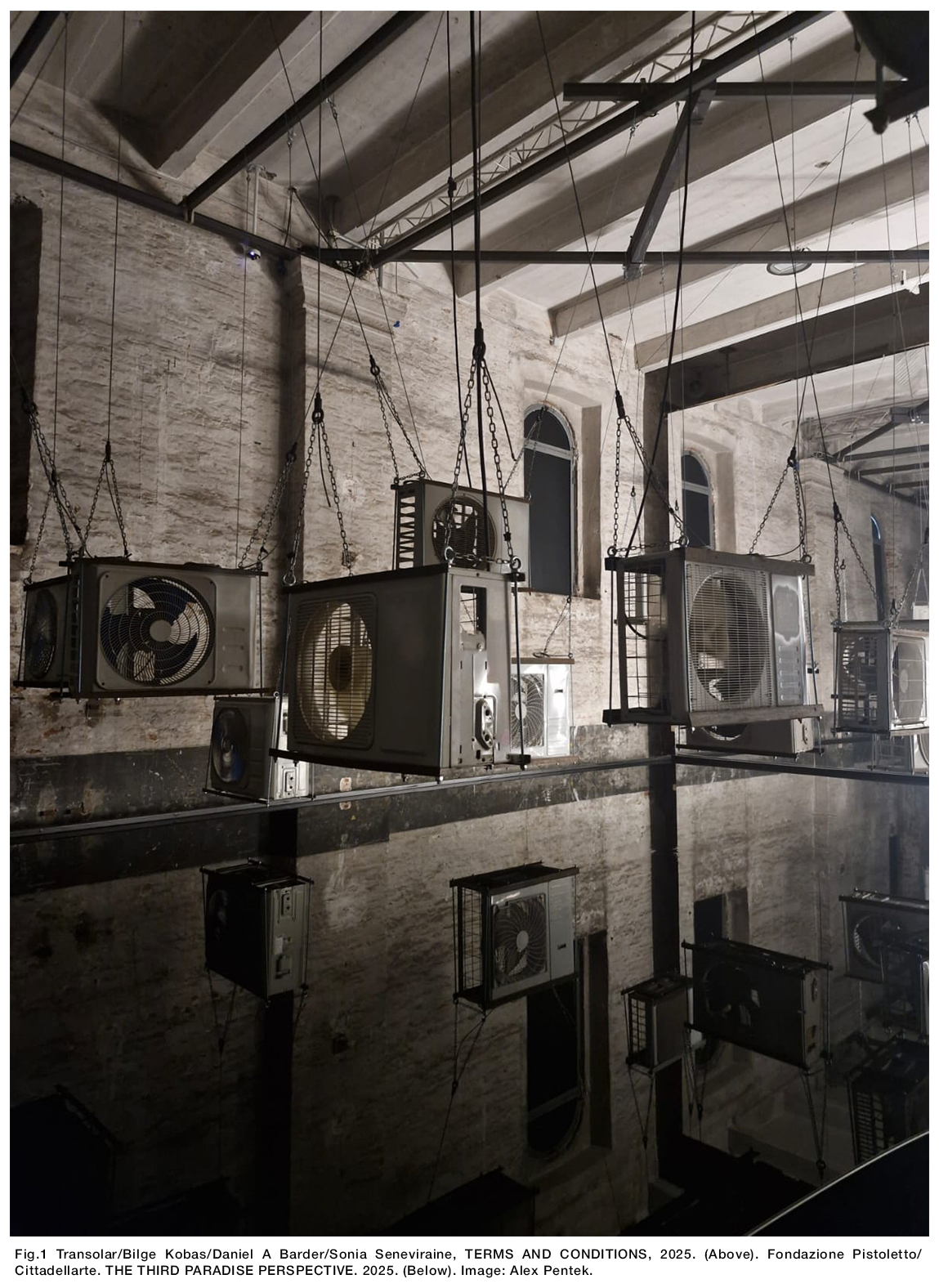
The Biennale is mainly shown at the Arsenale building (a re-purposed rope factory), and the Giardini, where a selection of countries from around the world have had permanent and temporary pavilions since 1907. Entering the Arsenale building through heavy thermal curtains, the first large exhibit to encounter is the dark, disorienting atmosphere of TERMS AND CONDITIONS by Transolar/Bilge Kobas/Daniel A Barder/Sonia Seneviraine, (Germany), and THE THIRD PARADISE PERSPECTIVE, by Fondazione Pistoletto/Cittadellarte, (Italy). In almost complete darkness this series of suspended air-conditioning units exudes heat and steam over a winding pathway between raised reflective pools of water, representing how we must negotiate our future path amidst ongoing climate change. (See fig.1).
Moving through the large industrial L-shaped building, different architect teams from around the world create a dizzying journey exploring the theme of how to collectively deal with change. Passing several impressive AI and voice activated robotics displays, BIOROCK PAVILION quietly explores the first example of ‘adaptive growth’ in architecture. This proposes to grow a biomimetic, graceful, shell-like pavilion from mineral deposits using undersea electrolysis to a light weight metal frame. Kelly Hill, Michael Pawlyn/Adam Holloway/Karen Bird/Ed Clark/Andy Hayles/Jon Stevens, (UK).
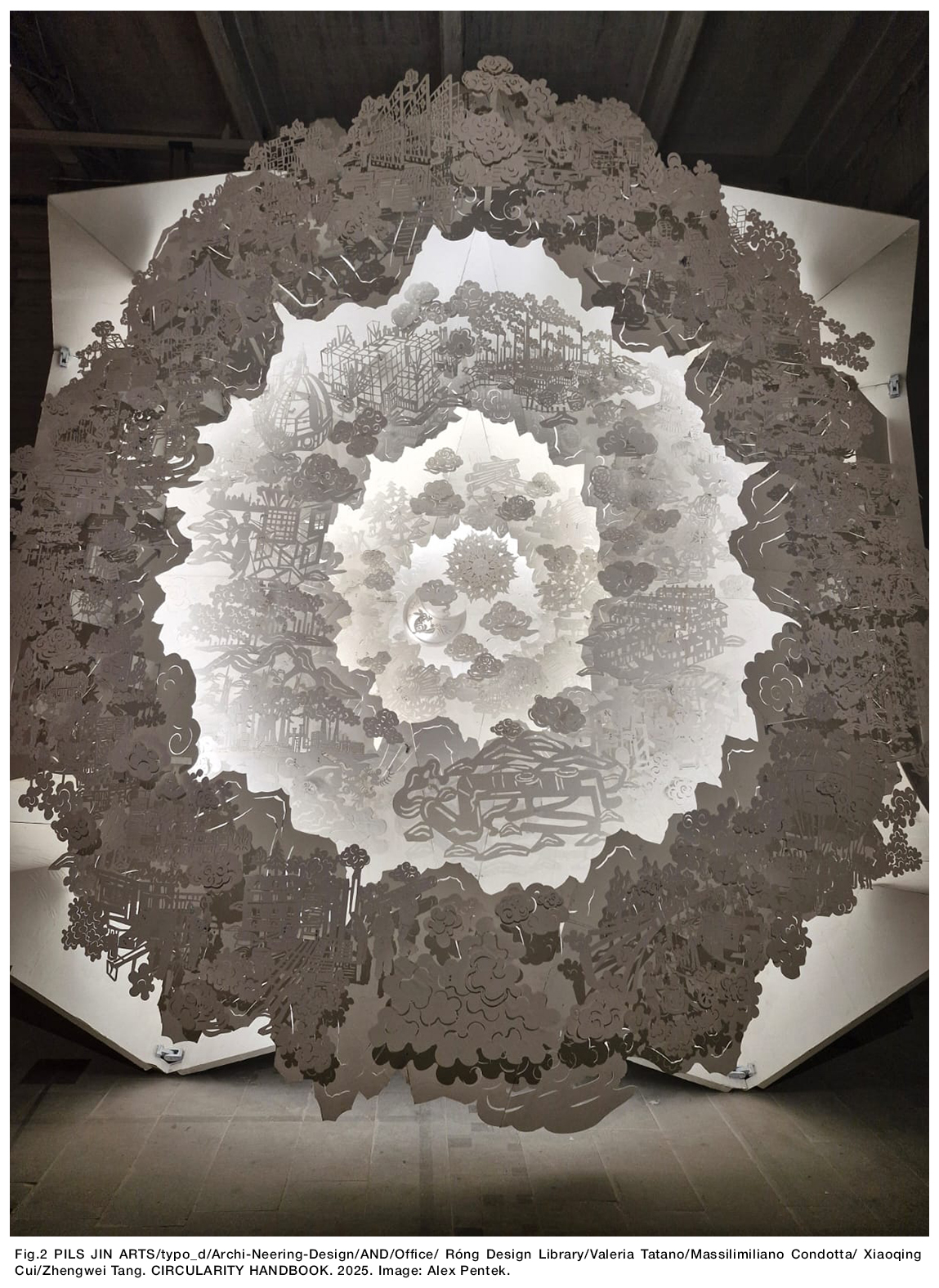
Having attended many architecture and art biennales over the years, this year’s architecture biennale strongly addresses the viewer by aesthetically reinventing each space: CIRCULARITY HANDBOOK is a delicate paper and card cut-out installation facing the goal of creating zero waste. This captivating display emphasises a Buddhist cycle of interconnectedness between the built and natural environment, and is an an embodiment of the accompanying printed handbook. PILS JIN ARTS/ typo_d/ Archi-Neering-Design/ AND/ Office/ Róng Design Library/Valeria Tatano/Massilimiliano Condotta/Xiaoqing Cui/Zhengwei Tang, (China). (See Fig.2)
While architecture and art both sit comfortably under the umbrella of ‘the arts’, generally there are differences between both Biennales, ranging from subjective, expressive, discursive, and ambiguous artistic approaches often contrasting more collective, socially and philosophically engaged architectural exhibits. In recent years this gap is closing. While it is perhaps wrong to compare, in either case the more successful and impactful exhibits carefully integrate or contrast architecturally with the exhibition space. I always have enjoyed the philosophical tone of the Architecture Biennale, exploring the many ways different ideas are communicated. As well as experimentation there seems to be an unspoken emphasis on aesthetics across the Biennale, by which I mean each exhibit creates a strong visual and emotional response in the viewer whether by voice controlled robotics, 3D printed clay or tactile Earth and sand. I was not alone in finding it difficult to tell whether I was at an art or architecture biennale, which I found to be a positive experience!
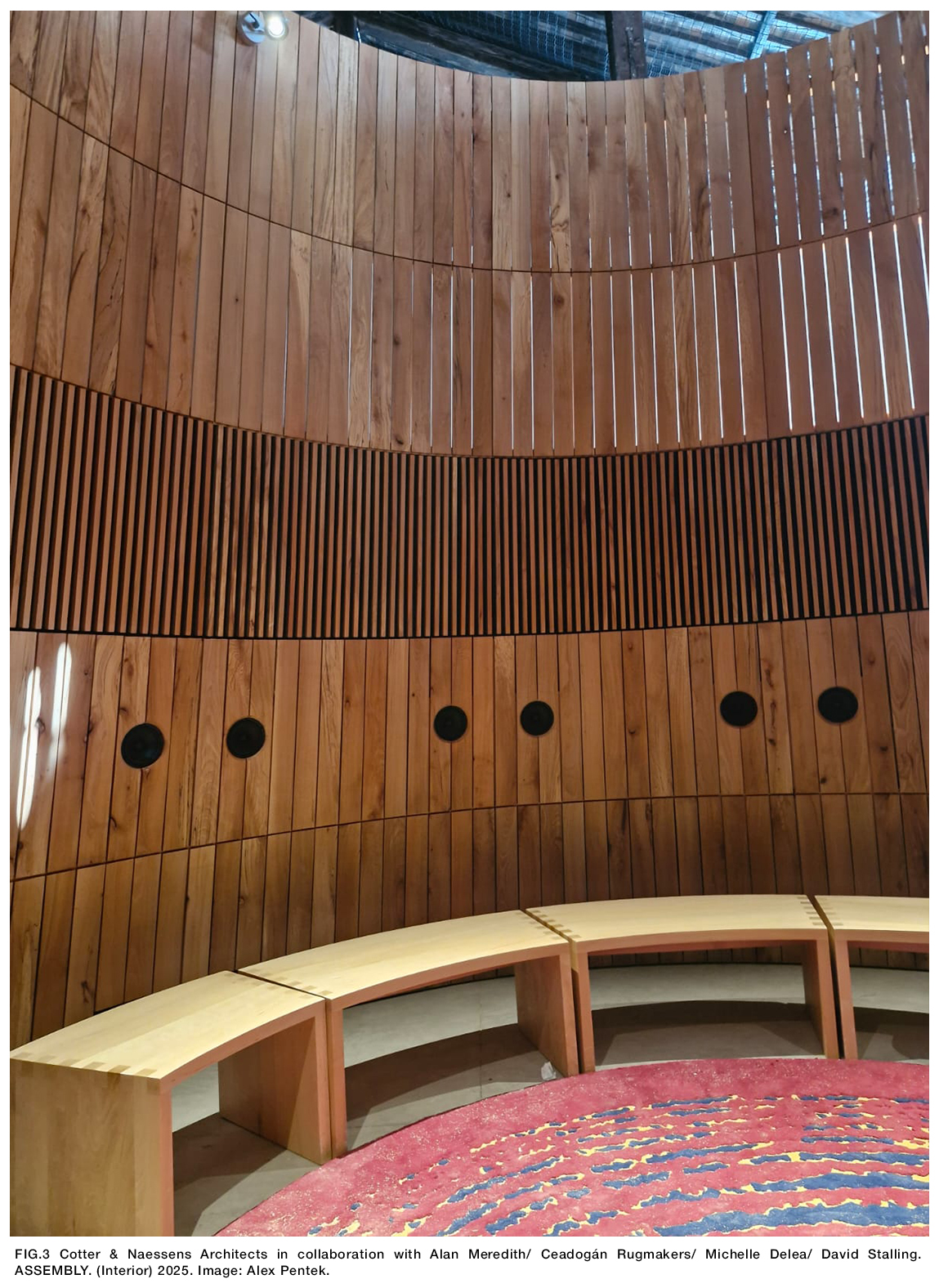
This year, Cotter & Naessens Architects curated and produced ASSEMBLY, an enigmatic collaborative installation combining sound art, craft, and poetry in an architectural pavilion beautifully made from handcrafted wood. Other recent Irish architectural exhibitions at Venice include ENTANGLEMENT, 2021, Annex group, critically looking at the environmental impact of Ireland’s rapidly growing data infrastructure, and IN SEARCH OF HY-BRASIL, 2023, curated by Peter Carroll, Peter Cody Elizabeth Hatz Mary Laheen and Joseph Mackey, which creatively explored Ireland’s mythical island culture and rural materiality on multiple scales, reflecting that year’s theme ‘Laboratory of the Future’. Despite these examples of radically different practices and curatorial approaches, geo- political and environmental themes weave a common thread between these contributions.
Cotter & Naessens, (Louise Cotter and David Naessens), are award winning architects based in Cork, and are known for their work at DLR Lexicon, Dun Laoghaire and the FOCAS Research Institute, Technical University Dublin. Previously taking part in CLOSE ENCOUNTERS, 2018, and in FREESPACE, 2021, they are no strangers to the Architecture Biennale. ASSEMBLY has been an opportunity for Cotter & Naessens to fully explore their design ethos informed by a mixture of design research, teaching, and competitions. Their conceptual approach embraces the political model of the ‘citizens assembly’ introduced in Ireland in 2016 to give agency and governance to ordinary citizens. This speaks to all of the biennale themes, especially the collective. This conceptual prototype is designed for non-hierarchical gatherings, communication, debate, and the sharing of ideas.
Amidst the cold industrial setting of the Arsenale building, ASSEMBLY warmly seems to glow in the space filtering sunlight through its vertical, circular louvered surfaces created by woodworker Alan Meredith from a naturally fallen beach tree. Entering this space and standing on a handwoven rug created by Ceadogán Rugmakers, surrounding curved seating allows conversations organically to strike up. Michelle Delea and David Stalling have collaborated to create an embedded sound element played over a series of built in speakers. This soundscape includes conversations around the making of the work mixed with music and sounds inspired by the Venetian fragmented choral tradition known as cori spezzatit. Speaking with Stalling at the launch, using multiple speakers is intended to create a disorienting, low volume omni-presence to the sound with no obvious source. This is enhanced by the tapered form of the work which optically appears to breath and move by its amphitheatre-like, vertically disorienting structure. Having been very well received in Venice, ASSEMBLY will return to Cork for a touring exhibition in Ireland in 2026 with details to be confirmed later this year.
Image credits:
Fig.1 Transolar/Bilge Kobas/Daniel A Barder/Sonia Seneviraine, TERMS AND CONDITIONS, 2025. (Above). Fondazione Pistoletto/Cittadellarte. THE THIRD PARADISE PERSPECTIVE. 2025. (Below). Image: Alex Pentek.
Fig.2 PILS JIN ARTS/typo_d/Archi-Neering-Design/AND/Office/ Róng Design Library/Valeria Tatano/Massilimiliano Condotta/ Xiaoqing Cui/Zhengwei Tang. CIRCULARITY HANDBOOK. 2025. Image: Alex Pentek.
FIG.3 Cotter & Naessens Architects in collaboration with Alan Meredith/Ceadogán Rugmakers/Michelle Delea/David Stalling. ASSEMBLY. (Interior) 2025. Image: Alex Pentek.